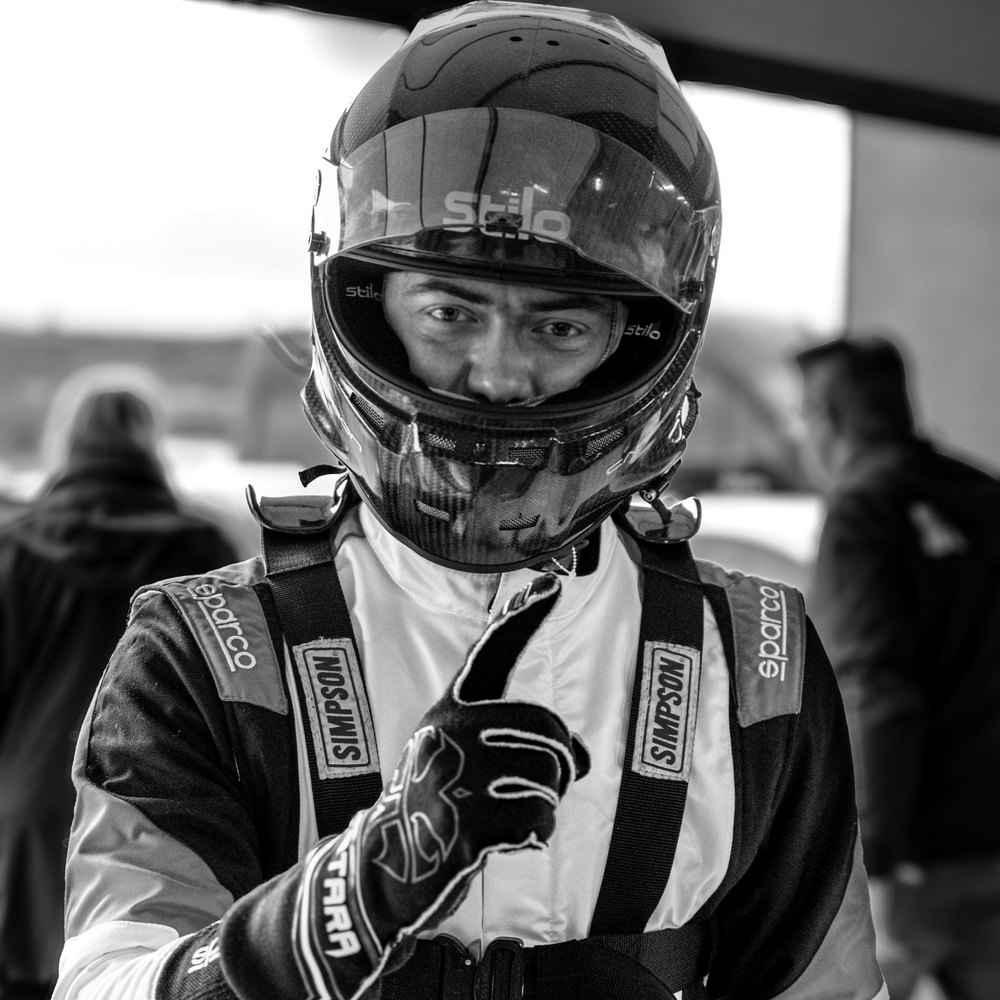
I learned more circuits on a simulator than I ever did in a car. Before my first proper test at Zandvoort I had done hundreds of laps of it on the sim, and by lap five in reality my braking references were already close. That is the honest version of the sim-to-real story: the sim is a serious training tool, and it is nothing like the real thing in exactly the areas that decide whether you can actually drive.
This is the answer I give every sim racer who asks me how to make the jump from sim racing to real racing. What transfers, what does not, which routes onto a real grid actually exist, and what both worlds cost over a season.
What actually transfers from the sim
Track knowledge transfers almost one to one. Laser-scanned circuits on iRacing, Assetto Corsa and rFactor are accurate enough that braking markers, kerb usage, camber changes and blind apexes carry straight over. A driver who has done 300 sim laps of Spa arrives at Eau Rouge knowing where the track goes, which is worth real lap time on day one and, more importantly, real safety. Learning a circuit on the sim before a test day is the single cheapest performance gain in motorsport.
Consistency transfers. The discipline of hitting the same brake point, the same apex and the same exit kerb twenty laps in a row is the most underrated skill in racing, and serious sim racers have drilled it for thousands of laps. Coaches can fix a slow driver who is consistent. They struggle with a fast driver who is random.
Racecraft transfers surprisingly well. If you have raced in organised leagues, you already understand defending on the inside, timing a move over several corners instead of lunging, managing a gap behind a safety car, and not winning the race into turn one. Starts, restarts, pit windows and basic fuel and tyre strategy in endurance sims all map onto reality. The first time I raced against a strong sim league graduate in a kart, his positioning was better than drivers with two seasons of real experience.
Procedures and pressure transfer too. One-lap qualifying with everything on the line feels almost the same on both sides of the screen. So does the mental skill of resetting after a mistake mid-race instead of carrying it for three laps.
What the sim cannot give you
G-force. A senior kart on fresh slicks pulls forces your neck has never met in a rig, and a downforce car multiplies that again. The first real day, most sim racers are physically done after 20 minutes, and their lap times fall apart long before their understanding does. No direct drive wheel prepares your neck, forearms or core for this.
Fear and consequence. On the sim, the worst outcome of a mistake is a reset. In reality, the crash costs money and can hurt, and your brain knows it. That recalibrates risk in every braking zone. Some sim racers adapt in a weekend. Others need a full season before they commit to a real overtake the way they did online. Neither reaction says anything about talent, but you only find out in a real car.
Tyre feel. Force feedback gives you steering torque and nothing else. In reality you read grip through your backside, your chest and your inner ear: the small slip before the rear lets go, the tyre coming up to temperature over three laps, the surface changing as rubber goes down. This is the part of driving that takes real seat time, and there is no shortcut.
Heat and physical stress. A GT cockpit in summer can sit well above 40 degrees, and a 30 minute kart final is a cardio event. This gap is exactly why I built the training and nutrition plans in DriversPerformance around neck strength, heat tolerance and conditioning rather than generic gym work. If you are serious about crossing over, start a driver fitness program months before your first test, not after it.
The sim-to-real routes that actually exist
The proof of concept is GT Academy, the Nissan and PlayStation program that ran from 2008 to 2016. The first winner, Lucas Ordóñez, went from Gran Turismo to a class podium at the Le Mans 24 Hours in LMP2. Jann Mardenborough, the 2011 winner, raced at Le Mans, scored in GP3 against career single-seater drivers, and spent years as a professional in Japan's Super GT. These were not marketing stunts. They were real careers built from a game.
World's Fastest Gamer continued the idea. Rudy van Buren won the 2017 edition and became a simulator driver for McLaren's Formula 1 team. James Baldwin won in 2019, earned a British GT seat in a McLaren 720S GT3, and won on his real-car debut. On the oval side, William Byron built his early skills on iRacing before climbing the NASCAR ladder to Cup level.
Today the routes look like this: Formula 1 teams employ full-time simulator drivers, manufacturers such as Porsche run large esports programs around their one-make competitions, and newer projects like Racing Prodigy award real racing licenses and race weeks to sim racers who win their events. Esports prize money itself can also fund real seat time, which is how several club racers I know paid for their first season.
Be honest about the odds, though. Tens of thousands of drivers enter these competitions and a handful get paid seats. Treat talent programs as a lottery ticket you buy on the side, not as your plan. The reliable route from sim racing to real racing is the same one everyone else uses: start small, pay for it, and be quick.
Realistic first steps onto a real grid
Step one: a rental kart league. Almost every region has competitive hire karting championships where a full season costs €1,200 to €2,500. The karts are heavy and slow compared to what you race online, which is exactly the point: you learn real tyre feel, real contact and real consequence for a few hundred euro a month. Sim racers who skip this step usually regret it.
Step two: owner-driver club karting. A tidy second-hand IAME X30 or Rotax Max package costs €2,500 to €4,000, and a club season on top of that runs roughly €5,000 to €8,000 with tyres, entries, fuel and engine work. This is where sim consistency really starts paying off, because club karting rewards drivers who can repeat laps all day. I broke down the full numbers in what karting really costs.
Step three: club car racing. Get your national race licence (in the UK that means the ARDS test, around €350 including the medical), then look at budget endurance racing. Series built around the Citroën C1 or Ford Ka in Europe let you share a car with three or four drivers for €1,000 to €1,500 per race, which buys hours of real seat time instead of eight-lap sprints. In the US, Spec Miata plays the same role: cheap, huge grids, brutal racecraft education. Adults who were never going to be F4 drivers still race hard every month in these categories, and the pace at the front is higher than most people expect.
Whichever step you start at, book a private test day with a coach before your first race. One day of structured real-car feedback is worth a month of guessing, and it tells you quickly which sim habits are helping and which are lying to you.
Budget: a sim season versus an entry-level real season
Here are the two worlds side by side, with numbers nobody usually puts in the same table. These are realistic mid-points, not best cases.
| Route | First year | Years after | What you get |
|---|---|---|---|
| Competitive sim season (iRacing plus leagues) | €2,500 to €5,000 incl. rig and PC | €500 to €1,000 | Unlimited laps, strong racecraft, zero physical adaptation |
| Rental kart league | €1,200 to €2,500 | Same | Real tyre feel and contact at minimum cost |
| Owner club karting (X30 or Rotax Max) | €8,000 to €12,000 incl. used kart | €5,000 to €8,000 | Proper race weekends, real setup work, a results CV |
| Budget endurance share (C1 or Ka class) | €4,000 to €7,000 | Similar | Hours of car seat time, traffic, pit stops, night racing |
| Club car racing, own car (Spec Miata level) | €18,000 to €30,000 incl. car | €10,000 to €15,000 | Full ownership of your program and your weekends |
Read the table both ways. Yes, a real season costs five to ten times a sim season, and that gap is why sim racing exists as a sport in its own right. But a shared endurance seat costs less than many people spend upgrading a rig, and it buys the one thing no simulator sells: real seat time. If the budget is the blocker, that is a solvable problem before it is a talent problem, and I wrote up the practical options in how to fund a racing season.
The smart move is not choosing one world. Every professional I know runs both: real races for the career, sim laps for preparation. Max Verstappen races online between Grands Prix, and club drivers should copy that model in miniature, because the sim keeps your references sharp between real weekends at almost no cost.
So make it concrete. This month, book one rental kart session and drive it back to back with your usual sim stint, then write down what felt different: the grip, the heat, your neck, your fear level in traffic. That one page of notes is your real starting point. Next month, do a league night at the rental track and a test day in a club kart. Keep the rig, keep the league racing, and let the sim do what it does best, which is making your real seat time cheaper and your real laps better.